
How Much Hill Training Do You Actually Need for the St. George Marathon?


Hill Training for St. George?
A clear, practical guide to getting ready for the course without overdoing the climbing or trashing your legs.
If you're training for the St. George Marathon, sooner or later somebody is going to tell you one of two things:
"You need to run hills every day."
Or...
"Don't worry about the hills. It's mostly downhill."
Neither is completely true.
After helping runners prepare for St. George for years, here's what I can tell you:
You absolutely need both uphill and downhill training.
Not because the course is impossible.
But because the course is sneaky.
Most runners remember Veyo Hill.
What they forget is everything that comes after it.
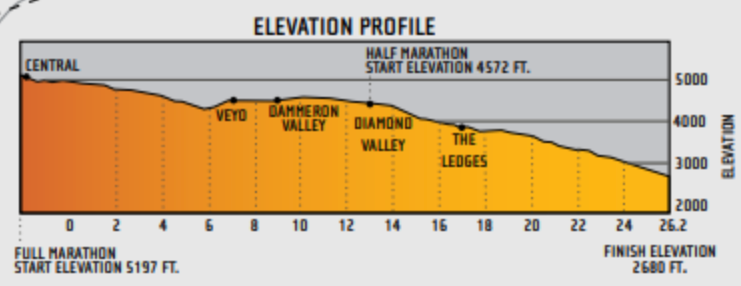
How St. George Will Humble You
My first time running St George, I thought I understood the course.
I had done plenty of running.
I was fit.
I knew about Veyo.
I figured once I got over that climb, I'd be home free.
Turns out St. George had other plans.
Because while Veyo gets all the attention, the course keeps asking questions long after that climb is over.
There's the long climb from Dammeron Valley toward Diamond Valley.
The rollers through Winchester.
The smaller climbs as you get closer to town.
None of them are individually terrifying.
But when they show up after you've already run 15, 18, or 22 miles?
They suddenly feel a lot bigger.
That's why I tell athletes that St. George is not a downhill marathon.
It's a marathon that happens to lose elevation.
Those are very different things.

Picture from Fastcory.com
Why You Need Uphill Training
The climbs at St. George aren't technical.
They're not steep mountain trails.
But they are long enough to expose weaknesses.
Hill training builds:
Leg strength
Running-specific power
Better posture
More efficient climbing mechanics
Mental confidence
When you've practiced climbing during training, Veyo doesn't feel like an obstacle.
It feels familiar.
And familiar is powerful on race day.
For most runners, I recommend at least one hill-focused workout each week during the build.
That could be:
Hill repeats
Sustained climbs at marathon effort
Long runs on rolling terrain
Treadmill incline workouts
You don't need to become a mountain goat.
But you do need enough climbing that your body knows what to do when the road tilts upward.
The Downhill Side Nobody Talks About
Here's where I think many runners get themselves into trouble.
They train the climbs, and not down hills. Others hear St George is down hill and do it the other way around.
The reality is that downhill running creates tremendous stress on the quads.
Every step is essentially a controlled braking action.
Now multiply that by thousands of steps.
I've worked with runners whose cardiovascular fitness was ready for a marathon PR.
Their legs weren't.
Their heart rate looked great.
Their lungs felt great.
Their quads completely quit.
That's the St. George lesson.
Your fitness gets you to mile 20.
Your durability gets you to the finish line.

The Secret Is Learning to Run Downhill Efficiently
Downhill training isn't about bombing down mountains.
It's about learning control.
Quick cadence.
Relaxed posture.
Minimal braking.
Strong quads.
Good mechanics.
I often tell athletes that St. George doesn't reward the runner who runs the fastest downhill at mile 5.
It rewards the runner who can still run downhill efficiently at mile 23.
Those are two very different skill sets.
How Much Hill Training Is Enough?
For most runners preparing specifically for St. George, I like to see:
Weekly
One dedicated hill workout
Every 2-3 Weeks
A long run with meaningful climbing and descending
Last 8-10 Weeks Before Race Day
Course-specific long runs whenever possible
If you're local, that might mean:
Veyo
Dammeron Valley
Diamond Valley
Winchester Hills
Snow Canyon
Red Hills Parkway
The goal isn't copying the exact course.
The goal is preparing for the demands of the course.

If You Live Somewhere Flat
I hear this concern all the time. "I don't have hills where I live."
You probably have more options than you think!
Bridges.
Parking garages.
Treadmills.
Overpasses.
Neighborhood rollers.
Even incline walking on a treadmill can be useful.
The body doesn't care where the work comes from.
It only knows whether the work was done.
I've coached runners from some of the flattest places who have had fantastic races in St. George because they consistently found ways to mimic the demands of the course.
Perfect terrain is nice.
Consistent training is better.
The Biggest Mistake I See
Trying to train too hard on the hills.
I've seen runners turn every hill workout into a race.
Every long run into a sufferfest.
Every climb into a competition.
Then they wonder why they're exhausted by August.
Remember:
You're not training for a hill workout.
You're training for a marathon.
The hill work should make you stronger, not leave you constantly trying to recover.
My Advice
If you're training for St. George, don't ignore the hills.
But don't obsess over them either.
Respect the course.
Train both uphill and downhill.
Build strong, durable legs.
Practice climbing efficiently.
Practice descending efficiently.
And remember that the runners who race St. George best are usually not the runners who fear the hills.
They're the runners who have spent months making the hills feel normal.
Because when Veyo shows up on race day, you don't want to be meeting it for the first time.
You want to look at it and think:
"Yep. We've done this before."
Here’s to a strong, healthy St George Marathon!
Happy running
Dayna - your fav. Exercise Physiologist
Want more St Goerge Marathon training tips? Give there last podcast a listen - you might just know who is talking :-)

Our next Master Class is coming up - great timing in your Marathon training to tune up your form for injury free running!

Efficient. Strong. Injury-Free.
Need help getting started? I specialize in working with runners across the U.S. to help them build smart, strong, sustainable plans. Whether you’re looking for custom coaching, strength programming, or support with gait, mobility, or fueling—I’ve got you covered.
I have a few spots open for my online run coaching!
📩 Reach out today and let’s set you up for success on October 3rd.

Want more help?
Join our Running Workshop here!
Or
Learn how you can run more efficiently Running Assessment
Or
Get your FREE Strength Assessment here!
Or
Join our online 12-week strength program here!


Comments