
Why Does the Same Running Pain Keep Coming Back?


Why Does the Same Running Pain Keep Coming Back?
Your Gait Cycle May Be the Missing Piece
You’ve tried ALL the things.
Your calves keep cramping, so you stretch more.
You increase your hydration. Add electrolytes. Buy new shoes. Roll your calves. Strengthen them.
And yet…there it is again.
Two miles into your run, your calf starts tightening.
Or maybe it’s your shin.
Those shin splints have been limiting your running for MONTHS. You cut your mileage. You iced. You rested. You went to physical therapy. They finally started feeling better…
So you try running again.
Half a mile in?
There’s that burning pain again.
At some point you have to ask:
What if the painful area isn't the entire problem?
What if we need to look at HOW your body is moving while you run?
That is where understanding your running gait cycle can be incredibly helpful.
First: What Is the Running Gait Cycle?

Your running gait cycle is basically everything that happens from the moment one foot hits the ground until that same foot hits the ground again.
We can simplify it into two big parts:
STANCE: Your foot is on the ground. You land, absorb force, support your body and propel yourself forward.
SWING: Your foot leaves the ground, the leg recovers underneath you and prepares for the next step.
Unlike walking, running also includes a period when neither foot is touching the ground.
It all happens incredibly quickly.
But here's what matters:
You repeat that cycle thousands of times during a run.
A movement pattern that isn't a big deal for three steps can become a very different story after 5,000, 10,000 or 20,000 steps.
Why Does Your Gait Cycle Matter?
Your body has to do several jobs with every running stride:
Absorb load.
Stabilize your body.
Store and return energy.
Move you forward.
Recover the leg for the next step.
And your ankle, calf, knee, hip, pelvis, trunk and arms all play a role.
If one area isn't contributing well, another area may have to do more work.
That doesn't automatically mean you will get injured. Running injuries are multifactorial—training load, recovery, strength, mobility, previous injuries and tissue capacity all matter.
But your gait can give us another piece of the puzzle.
And sometimes it's the piece runners have never looked at.
Where in Your Gait Cycle Is the Problem Happening?
This is one of the reasons I love looking at runners in slow motion.
Rather than simply saying:
"Your shin hurts."
I want to know:
What's happening right BEFORE and WHEN that shin is being loaded?
Let's look at a few examples.
1. Initial Contact + Loading: Are You Braking?

When your foot hits the ground, your body has to manage force.
If your foot consistently lands well out in front of your center of mass—what we often call overstriding—you may create more of a braking action with each step.
Instead of your momentum continuing smoothly forward, you're essentially asking your body to absorb that braking force…and then produce force again to move forward.
That can change loading through the lower leg and knee.
Research on running cadence and stride length shows that increasing step rate in appropriate runners tends to shorten stride length and can reduce braking impulse and several loads at the hip and knee. But this doesn't mean every runner needs some magic cadence number.
For the runner battling persistent shin pain, where the foot is landing and how the body accepts load may be something worth looking at.
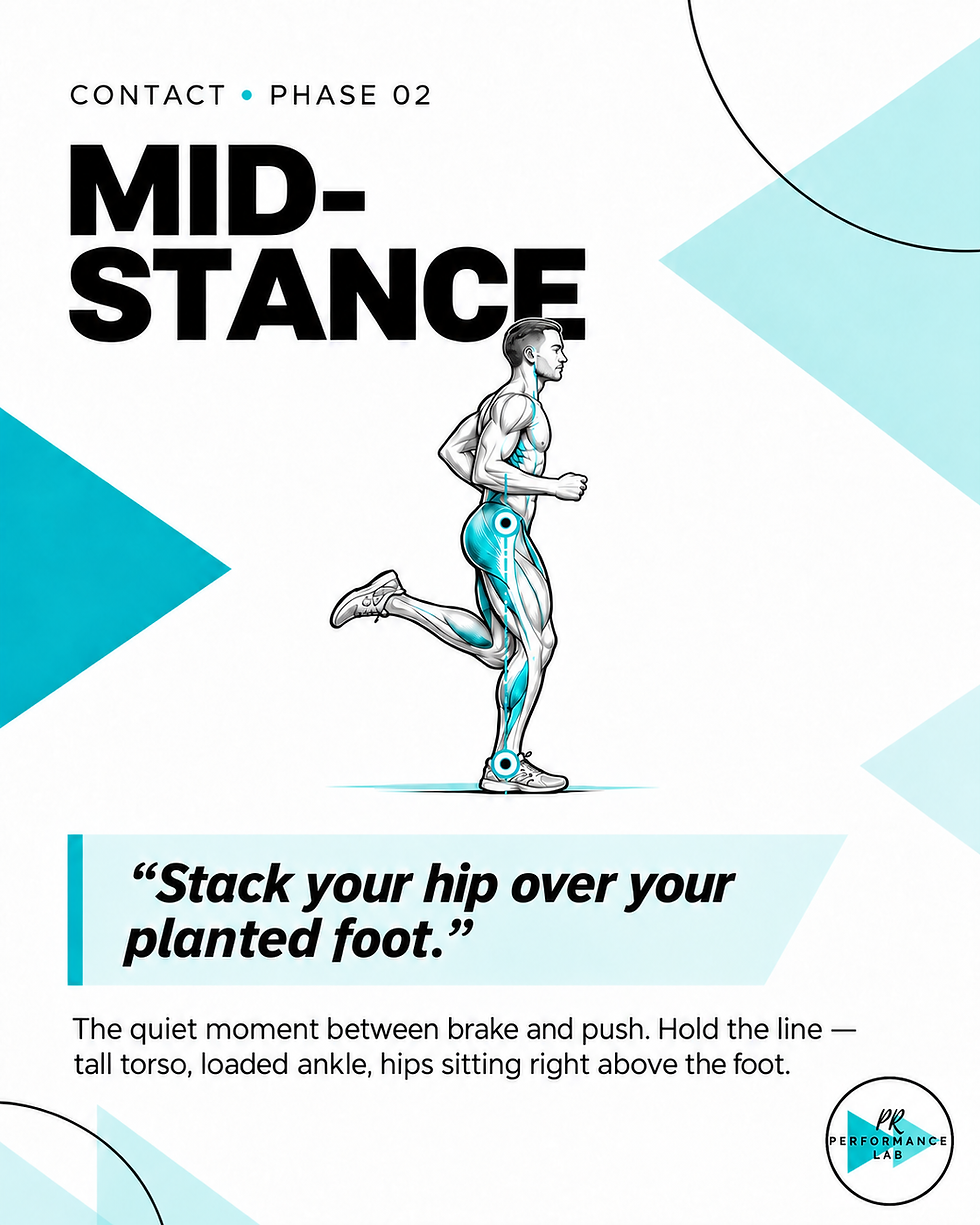
2. Midstance: Can Your Body Control You on One Leg?
Here's something runners sometimes forget:
Running is essentially a series of single-leg landings.
During midstance, your entire body has to control itself over ONE leg.
What's happening at the foot?
What's happening at the knee?
Is the pelvis staying controlled?
Is the hip dropping?
Is the leg crossing toward the center of the body?
Is your trunk compensating?
Weakness, limited mobility or movement strategies elsewhere in the chain can change how load gets distributed.
This is why treating only the spot that hurts doesn't always answer the bigger question.
3. Propulsion: WHERE Are You Getting Your Push?

Now your body needs to move forward.
Your calf and Achilles absolutely should contribute here.
But your hips should be part of the equation too.
If you're creating a lot of movement UP instead of FORWARD, or relying heavily on one part of the chain, you may be spending more energy than necessary—or repeatedly asking one tissue to do more work.
So when someone tells me:
"My calves always feel like they're doing ALL the work."
That gets my attention.
It doesn't mean their gait automatically caused their calf cramps. Cramping can involve fatigue, pacing, training, hydration, electrolyte status and other factors.
But I still want to see how they're producing force when they run.
Are they gliding forward?
Or are they bouncing?
Are the hips helping?
What happens as the foot leaves the ground?
Those are very different questions from simply telling someone to stretch their calves more.
4. Swing + Recovery: Can You Get Ready for the Next Step?
Once your foot leaves the ground, the leg has to recover underneath you and prepare for the next contact.
That recovery influences what happens on the NEXT landing.

Your gait cycle isn't a collection of separate pieces.
One phase sets up the next.
That's why changing something at the hip can sometimes change what we see at the foot.
And why the location of your pain doesn't necessarily tell us where the movement problem started.
What About Running Efficiency?
This is another big reason to look at gait.
If every stride includes excessive braking, unnecessary vertical movement or extra motion that isn't helping you move forward, you're asking your body to repeatedly manage that movement.
And that costs something.
But I don't believe every runner needs to be molded into one "perfect" running form.
Research backs up that idea too. Running biomechanics contribute to running economy, but there isn't one joint angle, foot strike or gait pattern that automatically makes everyone more economical. Higher cadence has shown a small association with lower energy cost, while lower vertical displacement has a somewhat stronger relationship with economy.
The goal isn't to make your running LOOK perfect.
The goal is to help YOUR body run efficiently and repeatedly tolerate the demands you're placing on it.
Don't Just Chase Where It Hurts
This may be my biggest takeaway for you this week.
If something hurts once after an unusually hard run, we don't need to immediately rebuild your running form.
But if you're saying:
"My calf ALWAYS cramps."
"My shin pain comes back every time I increase mileage."
"My knee feels fine until mile four and then starts hurting."
"I've done all the rehab, but every time I return to running the pain returns."
Those patterns are worth investigating.
Because the question isn't simply:
"What hurts?"
It's also:
"What is your body doing thousands of times before it starts hurting?"
Running Gait Is Only ONE Piece of the Puzzle
And this part is important.
Gait analysis shouldn't be:
"Your foot does this. Fix it."
I want to know the bigger picture.
What does your running look like?
What mobility do you have?
Where are you strong?
Where do you lack strength or control?
What has your training looked like?
What happens when you fatigue?
What shoes are you using?
What does the painful tissue currently have the capacity to handle?
Then we can decide whether changing something in your gait would actually be useful.
Because a running gait change should have a reason behind it.
Not just because Instagram told you everyone needs to run at 180 steps per minute.
Current reviews support gait retraining as a way to change loading variables, but the evidence that any single change universally prevents injury or improves performance is much less definitive.
The Takeaway
Your running stride happens so automatically that you probably don't think about it.
But your body repeats that movement thousands and thousands of times.
So if you've been treating the same calf, shin, knee, hip or Achilles problem over and over…
…and it keeps returning when you run…
It may be time to stop looking only at WHERE it hurts and start looking at HOW you run.
You don't necessarily need a completely different stride.
You need to understand your stride.
And sometimes a few specific changes to mobility, strength, training load or running mechanics can make a huge difference in how running feels.
Ready to stop guessing?
A Running Assessment looks at your running gait along with the strength, mobility and movement pieces that may be influencing it—so you leave knowing what to actually work on.
Let's figure out what's happening during YOUR gait cycle and get you running stronger, smoother and with less pain.
Happy Running!
Dayna, your favorite Exercise Physiologist & Run Coach
Your soreness or injury might also mean it is time for a Running Assessment, which always includes 8 weeks of strength exercises designed to help your individual needs found during the Running Assessment.

Want more help?
Join our Running Workshop here!
Or
Learn how you can run more efficiently Running Assessment
Or
Get your FREE Strength Assessment here!
Or
Join our online 12-week strength program here!


Comments