
Your Fall Marathon Is Closer Than You Think
- Dayna Player Robinson
- Jun 15
- 4 min read

Training for Fall Marathon?
Here's What To Focus On Right Now -> 5 months Out.
Last week I had the opportunity to be a guest on the St. George Marathon Podcast.
As we sat there talking about training plans, Veyo Hill, fueling, injuries, downhill running, and all the things that go into preparing for 26.2 miles, I found myself thinking about my own first St. George Marathon. It was 2006. The marathon was celebrating its 30th anniversary. This year it celebrates its 50th.
That makes me feel a little old.
Back then I didn't have twenty-plus years of coaching experience. I didn't own a performance lab. I hadn't worked with thousands of runners.
I was just another runner standing on the start line hoping I had done enough. And honestly, that's still one of the most common questions I hear from runners today.
"How do I know if I'm doing enough?"

Consistency. I know that's not exciting. Most runners want to talk about workouts. Or pace goals. Or how many miles they should be running.
But the truth is that none of that matters if you can't string together weeks of consistent training. This time of year should be about building your foundation.
Think of it like building a house. Nobody starts with the roof. You start with the foundation because everything else depends on it.
The runners who arrive healthy and confident in October are usually the runners who spent May and June doing the boring work.
They ran when they didn't feel like it.
They got their miles in when life was busy.
They didn't panic if they missed a workout.
They simply kept showing up.
That consistency becomes fitness.
Fitness becomes confidence.
And confidence becomes a much better race day experience.
One of the other things we talked about on the podcast was the fact that St. George is a downhill marathon. Whenever I say that, runners get excited.
Then I remind them that downhill doesn't always mean easier.
A lot of runners show up prepared for the distance but not prepared for the course. Those are two very different things.
Yes, St. George loses elevation.
But it also has Veyo Hill.
It has the rollers through Dammeron Valley.
It has long stretches where your quads are absorbing thousands of downhill impacts.
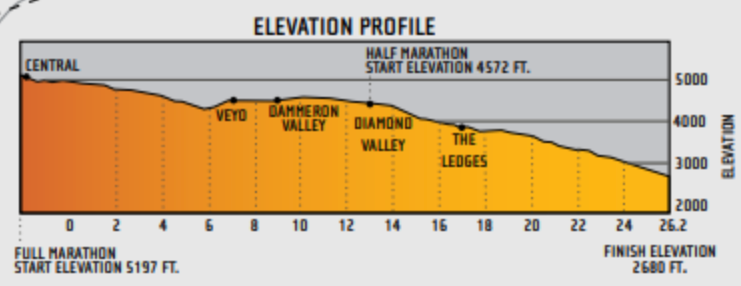
I've seen runners who were in great cardiovascular shape get absolutely destroyed by the course because their legs weren't prepared for the pounding.
Your lungs might feel amazing.
Your quads might be filing a formal complaint.
That's why I encourage runners to train on hills whenever possible.
If you live in Southern Utah, that's pretty easy. We almost have to try to avoid hills around here.
If you don't have access to hills, get creative. Use a treadmill.
Find an overpass. Run parking garages. Anything that teaches your body how to handle changes in terrain.
The goal isn't to perfectly recreate the course.
The goal is to prepare your body for the demands of the course.
Fueling
Another topic that came up during the podcast was fueling.
And I think this is where a lot of runners accidentally get themselves into trouble.
Many runners wait until race day to really think about nutrition.
That's backwards.
Training isn't just about teaching your legs to run farther.
It's also about teaching your stomach what to do.
Can your body handle the gel you're planning to use?
Can it handle sports drink?
How much sodium do you actually need?
What happens when it's hot?
What happens when you're three hours into a run?
Those are questions you want answered long before you stand on the start line.
One of my favorite marathon sayings is, "Nothing new on race day."
The only way to make that happen is to experiment during training.
Try the gels.
Try the hydration.
Try the shoes.
Try the socks.
Try the running belt.
Try all of it.
I'd rather have something fail during a Saturday long run than discover it at mile 20 of a marathon.
Know Your WHY!
And then there is one thing we talked about near the end of the podcast that I think might be the most important thing of all.
Your why.

That's when your why matters.
Why did you sign up?
What does this race mean to you?
What are you hoping to prove to yourself?
Some runners dedicate miles to family members.
Some focus on gratitude.
Some use mantras.
Some simply remind themselves that they chose this challenge.
Whatever your reason is, don't wait until race day to figure it out.
Know it now.
Because marathon training isn't just building stronger legs.
It's building a stronger mind.
The good news is that if you're reading this today, you still have time.
Time to build consistency.
Time to build strength.
Time to dial in your fueling.
Time to prepare for Veyo.
Time to remember why you signed up in the first place.
And if you do those things well, you'll arrive at that start line in October feeling a whole lot more prepared than you think.
Here’s to a strong, healthy Fall Marathon!
Happy Running
Dayna - your fav. Exercise Physiologist
Want more St Goerge Marathon training tips? Give their last podcast a listen - you might just know who is talking :-)

Efficient. Strong. Injury-Free.
Need help getting started? I specialize in working with runners across the U.S. to help them build smart, strong, sustainable plans. Whether you’re looking for custom coaching, strength programming, or support with gait, mobility, or fueling—I’ve got you covered.
I have a few spots open for my online run coaching!

Want more help?
Join our Running Workshop here!
Or
Learn how you can run more efficiently Running Assessment
Or
Get your FREE Strength Assessment here!
Or
Join our online 12-week strength program here!


Comments